Traditional “Press 1 for sales, press 2 for support” phone menus have had their day. Customers expect fast, natural, human-like interactions, not a maze of options and long hold times. That is where conversational IVR software comes in, transforming the way businesses handle customer calls.
By combining interactive voice response (IVR) with artificial intelligence and natural language processing (NLP), conversational IVR is a key component of digital-era contact center AI solutions, allowing callers to speak naturally and get assistance quickly. This enables smarter customer support with AI-driven call centers, resulting in happier customers, lower operational costs, and a more efficient contact center.
Modern businesses rely on advanced systems to handle increasing demands, and investing in cutting-edge computing technology for faster data processing and improved operational efficiency allows teams to respond more quickly to customer needs. Likewise, leveraging high-performance supercomputing infrastructure to analyze complex customer interactions in real time ensures that AI-driven tools like conversational IVR software work seamlessly under heavy loads. Financial planning also plays a critical role in supporting these innovations, and using comprehensive finance management strategies for technology investment and budget optimization can help businesses maximize ROI while maintaining high service standards. On the marketing side, integrating long-term online marketing strategies that enhance customer engagement and improve digital touchpoints ensures that AI-driven support aligns with broader brand goals. Similarly, applying innovative approaches to digital marketing campaigns that leverage AI insights for smarter targeting helps businesses reach customers effectively while keeping service interactions smooth and human-like. Together, these technology, finance, and marketing strategies create a cohesive ecosystem where conversational IVR software enhances customer experiences, reduces operational strain, and supports smarter, more responsive business operations.
Top 10 Contact Center Solutions for Conversational IVR Software
Selecting the right contact center solution is critical for businesses looking to deliver efficient and human-like customer experiences. With advancements in AI, modern platforms now offer conversational IVR software, intelligent call routing, and seamless omnichannel support. Here are the top solutions currently leading the market:
1. Bright Pattern – AI-Powered Contact Center Solution
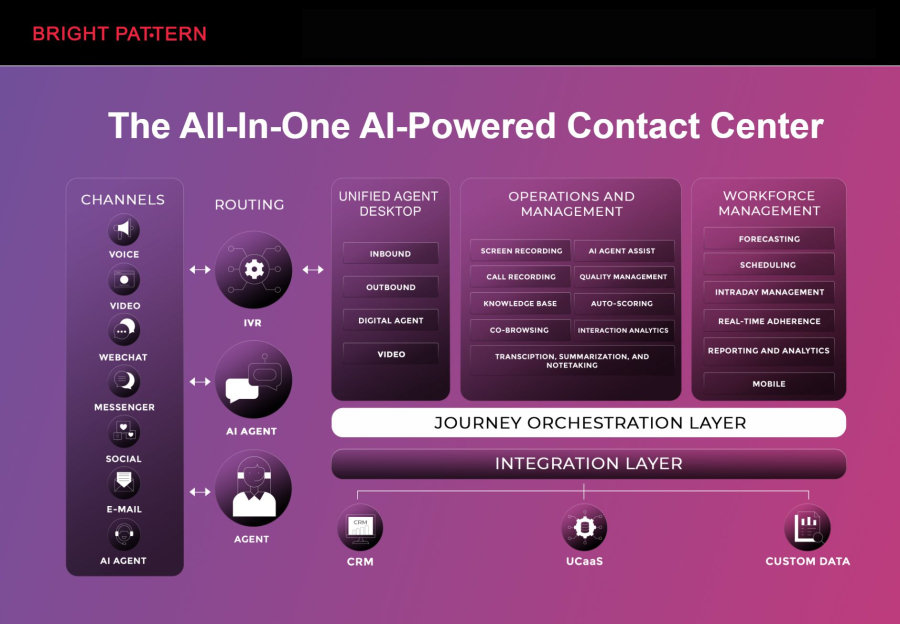
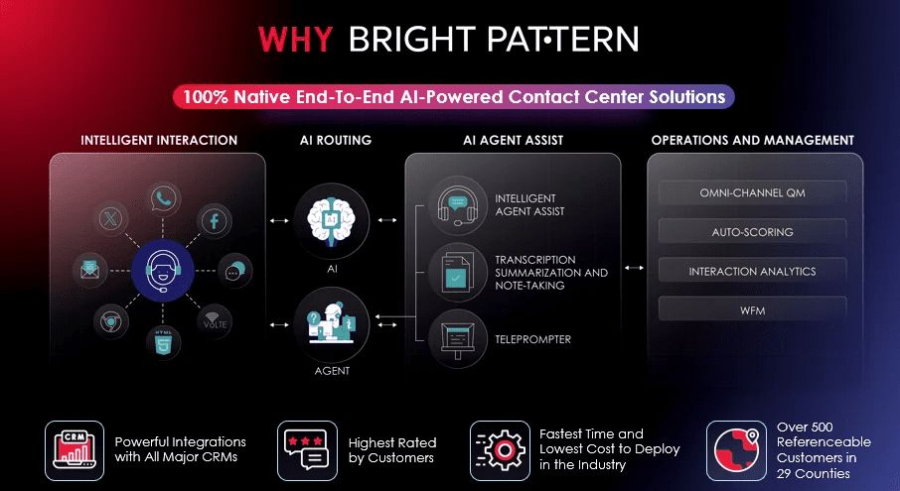
Bright Pattern stands out as a top choice for businesses seeking AI-driven call center solutions. Its platform integrates conversational IVR software with AI and machine learning to deliver smarter customer support. Companies can automate routine tasks, reduce hold times, and ensure more natural interactions with callers.
Key features of Bright Pattern include:
- AI-powered conversational IVR for natural voice interactions
- Omnichannel routing across voice, chat, email, and social media
- Real-time analytics and agent performance dashboards
- Smart automation for repetitive tasks, freeing agents for complex queries
- Integration with CRM and business applications for personalized customer experiences
Bright Pattern’s approach ensures that every interaction is seamless, efficient, and consistent, making it ideal for organizations that want to enhance customer satisfaction while optimizing operational costs.
2. Genesys Cloud
Genesys Cloud offers an AI-driven contact center platform that includes conversational IVR software, predictive routing, and advanced analytics. It supports multi-channel communication and provides tools for workforce optimization.
3. Five9 Intelligent Cloud Contact Center
Five9’s solution provides automated call handling with AI-powered IVR, CRM integration, and real-time reporting. The platform emphasizes scalability and flexibility for businesses of all sizes.
4. Talkdesk CX Cloud
Talkdesk CX Cloud combines AI and machine learning with conversational IVR, offering smart call routing, sentiment analysis, and self-service capabilities to improve customer interactions.
5. NICE inContact CXone
CXone delivers cloud-based contact center solutions with AI-assisted IVR, omnichannel routing, and workflow automation. It helps reduce handle times and improve first-call resolution rates.
6. RingCentral Contact Center
RingCentral provides a unified contact center experience with conversational IVR, AI-powered voice recognition, and integration with productivity tools to streamline operations and enhance customer engagement.
7. 8x8 Contact Center
8x8’s platform leverages AI for call analysis, conversational IVR, and predictive engagement. Its cloud-based solution allows organizations to scale quickly while maintaining consistent customer experiences.
8. Avaya OneCloud CCaaS
Avaya OneCloud CCaaS delivers a comprehensive contact center solution with AI-driven IVR, intelligent routing, and analytics tools. It supports multi-channel communications and enhances agent efficiency.
9. Amazon Connect
Amazon Connect offers a scalable cloud contact center with built-in AI services. It includes conversational IVR, voice recognition, and automated workflows to simplify customer interactions.
10. Cisco Contact Center
Cisco Contact Center solutions combine AI, conversational IVR software, and analytics to provide intelligent routing, personalized customer experiences, and robust reporting features.
What Is Conversational IVR Software?
Conversational IVRis the next generation of automated phone systems. Instead of rigid menus that force callers to follow a strict path, conversational IVR understands natural speech and can handle more flexible, human-style conversations.
In practice, it works like this: a caller says, “I want to check my order status” or “I need to update my address”, and the IVR understands the intent, asks a couple of clarifying questions if needed, then either completes the task or routes the caller to the right person.
Behind the scenes, conversational IVR typically combines several technologies:
- Speech recognitionto convert spoken words into text.
- Natural language understanding (NLU)to identify the caller’s intent and key details.
- Dialogue managementto decide what to ask or do next.
- Text-to-speechto respond in a natural-sounding voice.
- Integrationswith CRMs, ticketing tools, and back-office systems to actually get things done.
The result feels less like talking to a machine and more like speaking to a smart assistant that can help 24/7.
Why Businesses Are Switching to Conversational IVR
Organisations across sectors are moving from touch-tone IVR to conversational IVR because the benefits stack up quickly for both customers and the business.
1. Smoother, More Human Experiences
Customers no longer want to listen to long menus or remember which number to press. With conversational IVR they can just say what they need.
- Natural, free speechfeels more intuitive than navigating lists.
- Fewer dead endsbecause the system can re-ask or clarify rather than forcing a restart.
- Personalised responseswhen connected to customer data, such as greeting callers by name or offering tailored options.
2. Faster Resolution and Shorter Wait Times
A powerful advantage of conversational IVR is its ability to resolve a large share of routine enquiries without sending them to an agent. That directly reduces queues and speeds up service for everyone.
- Automated self-servicefor simple tasks like balance checks, password resets, appointment reminders, and order updates.
- Smarter routingso complex or high-value calls reach the right specialist first time.
- 24/7 coveragewithout needing overnight staffing, keeping service consistent at all hours.
3. Lower Operational Costs Without Sacrificing Quality
By automating repetitive tasks and optimising call flows, conversational IVR helps contact centres do more with less.
- Fewer calls to agentsbecause self-service handles the basic requests.
- Shorter average handling timeas callers are pre-qualified and routed correctly.
- Scalable servicethat can absorb spikes in volume without needing to rapidly increase headcount.
This cost-efficiency is especially attractive for organisations facing seasonal surges, marketing campaigns, or unexpected peaks in demand.
4. Richer Data and Better Decision-Making
Because conversational IVR turns spoken language into structured data, it gives you deeper insight into what customers really want and where friction exists.
- Analytics on intents(what people call about most often) to inform product, service, and staffing decisions.
- Journey analysisto see where callers drop off, get frustrated, or ask to speak to an agent.
- Continuous improvementas you use data to fine-tune flows, phrases, and self-service options.
Key Features to Look for in Conversational IVR Software
Not all conversational IVR platforms are created equal. When evaluating software, look beyond basic speech recognition and focus on features that directly support a better customer experience and smoother operations.
|
Feature |
Why It Matters |
|
Advanced speech recognition |
Accurately understands different accents, speech speeds, and phrasing, reducing errors and caller frustration. |
|
Natural language understanding (NLU) |
Identifies caller intent from free-form speech rather than relying on fixed phrases. |
|
Omnichannel consistency |
Uses the same intents and logic across voice, chat, and messaging for a connected experience. |
|
Integration with existing systems |
Connects to CRM, contact centre platforms, payment gateways, and back-end databases to complete tasks. |
|
Visual call-flow and dialogue builder |
Allows non-technical teams to design, update, and test conversation flows without heavy IT reliance. |
|
Context and memory |
Remembers details within a call so callers do not need to repeat information multiple times. |
|
Analytics and reporting |
Provides dashboards for call reasons, completion rates, handoff rates, and customer effort. |
|
Failover to live agents |
Offers a smooth handoff to a human when the system is unsure or the caller asks for help. |
|
Security and compliance features |
Supports secure authentication and helps meet industry regulations where applicable. |
How Conversational IVR Transforms the Customer Journey
Conversational IVR is not just a technology upgrade; it reshapes the entire voice channel experience. Here is how it can improve key moments along the customer journey.
Before a Call Reaches an Agent
The opening seconds of a call set the tone. Conversational IVR helps you start strong.
- Friendly greetingsthat instantly sound more human, using natural language rather than rigid script lines.
- Open questionssuch as “How can I help you today?” instead of a long menu.
- Automatic identificationusing caller ID, account numbers, or simple security questions to quickly pull up the right records.
During the Interaction
As the conversation unfolds, the IVR can guide callers through tasks or route them effectively.
- Dynamic promptsthat adapt to what the caller has already said, rather than repeating options.
- Clarifying questionswhen the system is unsure, instead of dropping the call or sending it to a generic queue.
- Proactive informationlike expected delivery dates, upcoming appointments, or relevant offers.
If and When an Agent Is Needed
For more complex or emotional issues, a human agent is usually the best option. Conversational IVR makes that handoff more efficient and more personal.
- Pre-qualificationso the agent already knows why the customer is calling and what has been tried.
- Warm transferswhere the IVR summary appears on the agent’s screen, minimising repetition.
- Prioritisationbased on customer segment, issue severity, or service-level agreements.
Real-World Use Cases for Conversational IVR
Conversational IVR software delivers value across a wide range of industries. Here are some common and effective use cases.
Banking and Financial Services
- Check balances, recent transactions, or card status by voice.
- Activate or lock a card without speaking to an agent.
- Route complex mortgage or investment queries to the most suitable specialist.
Retail and E-commerce
- Track orders by saying an order number or delivery postcode.
- Manage returns, refunds, or replacements through guided self-service flows.
- Provide store information, opening hours, or stock availability.
Utilities and Telecoms
- Report outages or technical issues in natural language.
- Take meter readings or usage details via voice input.
- Offer proactive updates on service issues, repairs, or planned maintenance.
Healthcare and Public Services
- Book, reschedule, or cancel appointments without waiting in a queue.
- Provide pre-visit instructions or reminders in a clear, accessible way.
- Route urgent queries to the right clinical or support team quickly.
Planning a Conversational IVR Project: Where to Start
A successful conversational IVR implementation is as much about strategy and design as it is about technology. These steps help you launch with confidence and deliver rapid wins.
1. Define Clear Goals and Success Metrics
Before you design any dialogues, decide what success looks like. Typical goals include:
- Increasing self-service call completion rates.
- Reducing average handling time for live agents.
- Improving customer satisfaction or Net Promoter Score on the voice channel.
- Lowering call abandonment and queue times.
Agree metrics and baselines so you can track progress and demonstrate value.
2. Identify High-Value Journeys to Automate First
Focus early efforts on simple, high-volume tasks where automation will have the biggest impact. Examples often include:
- Balance or order status checks.
- Appointment management.
- Password resets or simple account changes.
Start small, prove the concept, then expand to more complex journeys as the system and your team mature.
3. Design Conversations, Not Menus
Think in terms of natural dialogue rather than hierarchical options. Aim for:
- Plain, friendly languagethat sounds like your brand’s human agents.
- Short, clear promptsinstead of long instructions.
- Guided fallback pathswhen the system does not understand, so callers always have a way forward.
4. Involve Frontline Agents and Supervisors
Your agents talk to customers every day, so they know the real questions and sticking points. Involving them early helps you:
- Capture authentic phrasing customers use.
- Spot opportunities for automation that still feel helpful.
- Design smarter routing rules based on actual call reasons.
5. Test, Learn, and Iterate
Conversational IVR works best when you treat it as a living system that improves over time.
- Runpilot launcheswith a subset of callers or call types.
- Gather feedback from both customers and agents.
- Refine intents, prompts, and routing rules based on real-world performance.
Best Practices for a Delightful Conversational IVR Experience
Once your system is live, small details make a big difference to how customers perceive it. These best practices help keep experiences smooth and frustration-free.
Use Clear, Consistent Language
- Avoid jargon and internal terminology that callers might not recognise.
- Match the tone of your human agents to create a seamless feel.
- Keep questions and options short so they are easy to remember.
Give Callers Control
- Always offer a clear route to a human when needed, especially for sensitive issues.
- Let callers interrupt prompts when they already know what they want.
- Confirm key actions, such as payments or changes to personal details, before finalising.
Design for Real-World Conditions
- Expect background noise, interruptions, and imperfect audio quality.
- Use confirmation prompts when responses are unclear or critical.
- Test with different accents to ensure reliable understanding.
Respect Security and Privacy
- Use appropriate authentication methods for sensitive tasks.
- Minimise how often callers need to repeat or spell out personal information.
- Only collect data that is genuinely necessary to complete the task.
Measuring the Impact of Conversational IVR
To keep your conversational IVR delivering value, build regular measurement and optimisation into your operating rhythm. Useful metrics include:
- Containment rate– the percentage of calls resolved without a human agent.
- Call completion rate– how often callers successfully finish the task they started.
- Average handling time (AHT)– both in the IVR and for calls routed to agents.
- Transfer and escalation rates– where and why calls move from self-service to human support.
- Customer satisfaction (CSAT)– measured via short post-call surveys or follow-ups.
By tracking these indicators and pairing them with qualitative feedback, you can continuously refine flows, add new intents, and expand the value you get from your conversational IVR investment.
Future Trends: Where Conversational IVR Is Heading Next
Conversational IVR is evolving quickly as AI capabilities mature. While the fundamentals remain the same, several trends are shaping the next wave of customer experience.
- Deeper personalisationusing real-time data to tailor conversations and recommendations.
- Unified voice and digital journeyswhere context is preserved as customers move between channels.
- Emotion-aware responsesthat adapt prompts based on detected frustration or urgency.
- More natural voicesthat sound increasingly close to human speech, improving comfort and trust.
The businesses that benefit most will be those that treat conversational IVR as a strategic capability, not just a cost-cutting tool.
Bringing It All Together
Conversational IVR software turns the humble phone line into a powerful, always-on service channel that feels faster, friendlier, and far more flexible than legacy menus. By understanding what callers say in their own words, it can resolve routine tasks on the spot, route complex issues to the right experts, and free agents to focus on conversations that truly need a human touch.
With clear goals, thoughtful design, and a commitment to ongoing improvement, conversational IVR becomes more than a technical upgrade. It becomes a core part of how you deliver outstanding customer experiences, protect margins, and future-proof your contact centre for the years ahead.
